

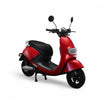
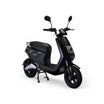
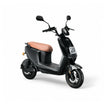
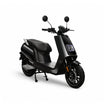
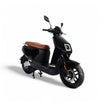
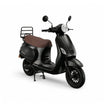
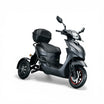
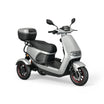
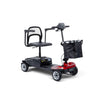
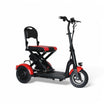
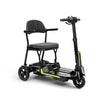

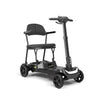
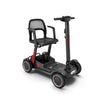
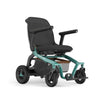
Buying a new scooter feels like freedom on two wheels, but before you turn the key, one thing has to be right: the scooter license plate. A license plate determines where you are allowed to ride, the speed limit, whether you need to wear a helmet, and which insurance is mandatory. In 2026, the rules regarding yellow and blue license plates were tightened in a few areas, and almost everything can be arranged online via the RDW. In this guide, you will read exactly which license plate your scooter needs, the difference between yellow and blue, how to apply for or transfer a license plate, the costs, and how to link appropriate insurance to your license plate.
Table of contents
- Does every scooter need a license plate?
- Yellow or blue license plate: the difference explained
- Applying for a scooter license plate: step-by-step plan 2026
- Transferring scooter ownership, re-registration, or without license plate
- Hit the road with your license plate: insurance and costs
- Frequently asked questions about scooter license plates
Important in brief
- Each moped, light moped and light scooter Anyone driving on public roads has needed a license plate since 2005 and must be registered with the RDW.
- A blue license plate belongs to a moped with max. 25 km/h; An yellow license plate for a moped with max. 45 km/h.
- Your dealer applies for a license plate for a new scooter; for an import or second-hand one, you arrange it yourself with the RDW starting from € 11,80 until approximately € 50.
- Since January 1, 2023, a helmet requirement for moped riders — so even with a blue license plate, you must wear a (lightweight) helmet.
- A scooter with a license plate is always mandatory third-party liability insurance, even when it is stationary. Fine for driving without insurance runs up to € 600.
Does every scooter need a license plate?
Yes, virtually every scooter that rides on public roads requires a license plate. Since September 1, 2005, all mopeds, light mopeds, and light scooters in the Netherlands are subject to registration. So, without a license plate on the back, you are not allowed on the road — not even a meter.
There are three groups of vehicles that do fall under the scooter category, but do not require a license plate:
- Scooters and e-scooters not required to have a license plate. The standard pedal scooter and some approved e-scooters fall under a different category. Please note: not every e-scooter is legally permitted on public roads.
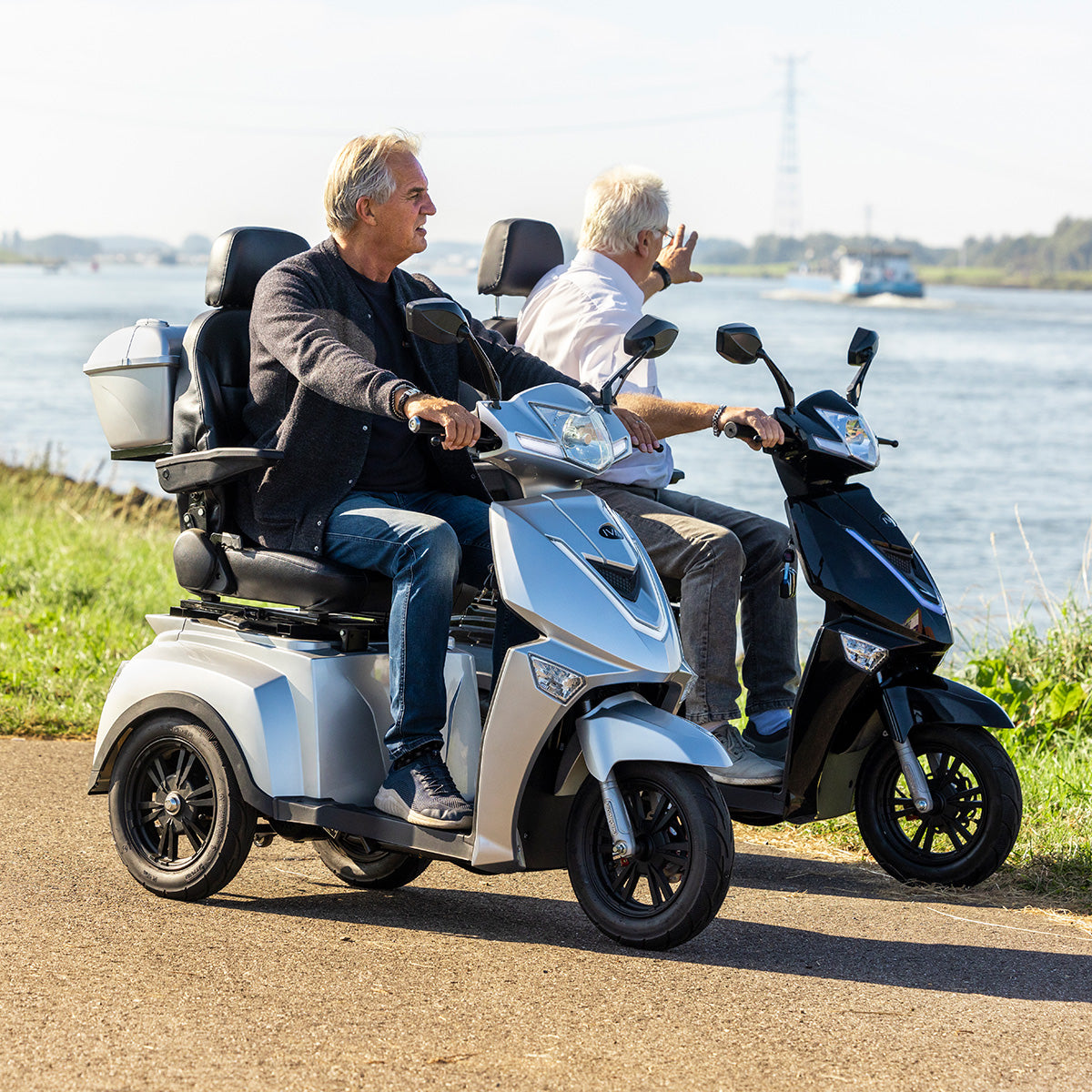
- Disabled vehicles and mobility scooters. A mobility scooter with a maximum speed of 45 km/h and an exemption falls under the category of disabled vehicles and does not need to be registered.
- Speed pedelecs. They actually have their own blue license plate (similar to a light moped) — do not confuse them with a regular e-bike.
For all other scooters, the rule is: no license plate, no public road. The RDW (National Road Traffic Authority) is the agency that issues, registers, and links license plates to an owner. A valid registration certificate is your official proof that the scooter belongs to you and meets Dutch requirements. You can find more details on the page. Applying for a license plate for a Dutch moped from the RDW.
An important difference between "license plate" and "registration certificate": the license plate is the combination of letters and numbers that appears on your plate, while the registration certificate is the card (or digital registration) that proves the vehicle is registered in your name. Both belong to the scooter and you must keep them safe.
Briefly summarized: Does your scooter ride on public roads and does it have a combustion or electric motor with more power than an e-bike? Then a license plate is mandatory.
Yellow or blue license plate: the difference explained
A yellow license plate belongs to a moped (max. 45 km/h), a blue license plate belongs to a light moped (max. 25 km/h). Both license plates are issued by the RDW, but subsequently determine a completely different set of traffic rules.
Comparison at a glance
| Subject | Blue license plate (moped) | Yellow license plate (moped) |
|---|---|---|
| Maximum speed | 25 km/h | 45 km/h |
| Minimum age | 16 years | 16 years |
| Driving license | AM | AM |
| Helmet | Lightweight helmet mandatory (from 2023) | Moped helmet mandatory |
| Where to drive | Cycle path where present, otherwise carriageway | Within the built-up area: carriageway. Outside the built-up area: bicycle/moped path. |
| Insurance | Mandatory (third-party liability minimum) | Mandatory (third-party liability minimum) |
| Amsterdam | Mandatory use of the road (since 2019) | Always on the carriageway within the built-up area |
How fast is a scooter with a yellow license plate allowed to go?
A scooter with a yellow license plate may a maximum of 45 km/h. That is the design speed for which the moped is approved. The scooter can run faster on a dynamometer, but on public roads, the maximum speed is 45 km/h. Driving faster results in a fine and can lead to the invalidation of the license plate.
How fast is a scooter with a blue license plate allowed to go?
A moped with a blue license plate may a maximum of 25 km/h. This applies both within and outside built-up areas. Due to the low speed, riding on a bicycle path is permitted (where a carriageway for mopeds is not mandatory). The RDW checks, via random checks and on the APK test bench, whether the moped still has its performance protection.
Is a scooter with a yellow license plate allowed on the bike path?
Within the built-up area, a moped with a yellow license plate drives on the lane, together with cars. On a ring road or outside built-up areas, you ride on the bicycle/moped path (if one exists). You are not allowed on the regular cycle path — there is a ban on mopeds there, indicated by the G11 sign (round sign with a bicycle symbol). With a blue license plate, you *are* allowed to ride on the cycle path, except in areas where this is locally prohibited (such as parts of Amsterdam).
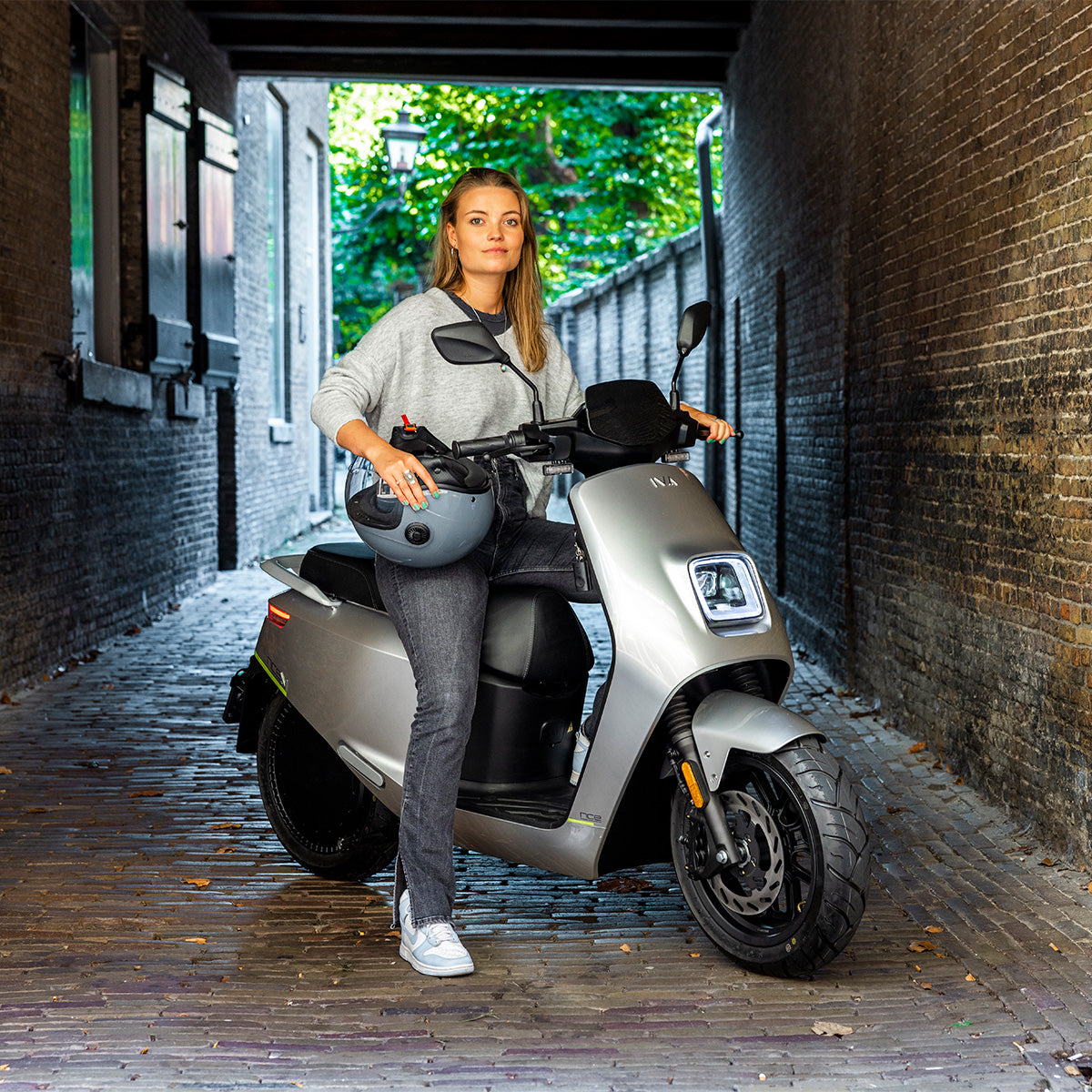
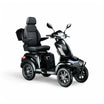
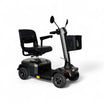
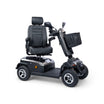
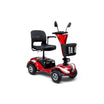
A moped is therefore a lightweight city scooter that allows you to easily weave through the city; a moped is more suitable for somewhat longer rides and higher speeds outside built-up areas. IVA Lux Electric mopeds come standard with blue license plates, while models like the IVA E-GO S4 be delivered with a yellow license plate at 45 km/h.
Applying for a scooter license plate: step-by-step plan 2026
In 2026, applying for a scooter license plate will largely be done online via the RDW. How it works differs depending on the situation: new, imported, or second-hand. Below you will find the step-by-step plan for each variant.
Step 1: Make a conscious choice for a yellow or blue license plate
With a new scooter, the factory software determines which category the scooter falls into. Our electric scooters are electronically limited: 25 km/h for light moped models, 45 km/h for scooter models.Do you want to drive faster or slower later? Then the scooter needs to be re-certified (see section 4). So choose the right variant when purchasing — you can find more info and advice at all IVA scooters.
Step 2: For a new scooter, the dealer arranges the license plate.
If you buy a new scooter from an authorized dealer, the dealer takes care of the license plate application and registration. You only need to valid identification and BSN to take along. The dealer registers the scooter in your name in the RDW system, you receive the registration certificate immediately, and the license plates are delivered or ordered. At IVA, this process is included in the purchase as standard — check with your IVA dealer in your area.
Step 3: Imported scooter? Apply for the license plate yourself at the RDW.
You must have a scooter imported from abroad identify and approve at an RDW inspection station. Steps:
- Make an appointment online for the moped inspection.
- Bring along: proof of identity, BSN, COC document (Certificate of Conformity), foreign vehicle registration certificate (if available), and VAT/purchase invoice.
- The RDW checks the frame, engine, speed limiter, and emissions.
- Upon approval, the scooter will be assigned a Dutch license plate.
- The RDW prepares the registration certificate and sends it within approximately five working days.
The cost of a moped inspection is approximately € 50, plus € 11,80 for the vehicle registration certificate. Count on a total of € 65-€ 80 for an import application.
Step 4: Second-hand scooter? Transfer of ownership is mandatory.
When purchasing a second-hand scooter, the license plate is still in the name of the previous owner. You must return the scooter within five working days Transfer the transfer to your name. You can read how to do that in the next section.
Step 5: Order your license plate
As soon as the scooter has a license plate, you order a license plate at an authorized license plate company (for example, a bicycle shop with an RDW permit, or online providers). You pay approximately € 25 to € 45 for a yellow or blue plate, depending on the type. Different dimensions apply to blue license plates (moped) than to yellow ones.
According to the National Government The license plate must be clearly visible and well lit after sunset. A dirty or damaged plate can result in a fine.
Conclusion: For a new IVA scooter, the dealer arranges everything within a single visit. For imports and second-hand scooters, you ride via an RDW inspection or transfer procedure that totals € 12 to € 80 cost.
Transferring scooter ownership, re-registration, or without license plate
Do you already own a scooter? Then there are a number of times when you need to deal with the registration again: transferring ownership upon sale, re-registration when changing from yellow to blue (or vice versa), and correctly deregistering if you sell or get rid of the scooter.
Transfer vehicle registration upon purchase or sale
Since 2014, you can arrange a transfer of ownership — better known as transferring ownership — in three ways:
- Online via Mijn RDW with DigiD. Fast, € 11,30, only possible if the seller cooperates and gives digital consent.
- At an RDW-approved company such as a post office with a transfer counter or dealer. Costs € 11,30 plus approximately € 7 administrative costs.
- At an RDW inspection station by appointment.
The buyer brings: proof of identity, registration certificate parts 1A and 1B (or the Title Debit Code), and the scooter itself does not need to be brought along. not along. Are you selling a scooter and do you know that the buyer will not transfer ownership immediately? Then ask indemnification via the RDW. Without a release of liability, motor vehicle tax, fines, and liability remain in your name.
Re-registration: from blue to yellow license plate (and vice versa)
Do you want to turn a light moped (blue) into a scooter (yellow) — or vice versa? That is called re-inspection and can only be done at an RDW inspection station. Steps:
- Make an appointment for an individual approval.
- The scooter is tested on the dynamometer for design speed (25 or 45 km/h).
- Upon approval, the scooter will receive a new registration certificate in the other category.
- You order a new license plate (yellow or blue).
The costs for re-certification are around € 50 inspection costs plus € 11,80 for the registration certificate and € 25-€ 45 for the new album. Count on € 85 to € 105 total. Not all scooters can be converted — first check if your model is allowed for both categories.
Scooter without a license plate: is that allowed?
A scooter without a license plate is allowed. not on public roads. However, you may ride an unregistered scooter:
- Driving on private property (enclosed yard, track).
- Transport on a trailer or in a van.
- Store as a classic car (from before September 1, 2005) without driving.
Anyone caught on a public road without a license plate will receive a fine of € 280 (2026) plus seizure risk. A souped-up scooter whose license plate has been revoked is subject to the same rules.
Deregister or suspend license plate
Are you not selling the scooter, but do not want to use it temporarily? Then you can the license plate suspend via Mijn RDW. During suspension, you do not pay road tax (although this does not apply to scooters anyway) and insurance is not mandatory. Suspension costs a one-time fee. € 28 and is valid for one year, with the option of extension. Selling or scrapping? Then deregister the license plate with an authorized dismantling company — this provides you with immediate release.
In summary: transferring costs € 11,30 and you do this within five working days of purchase. Re-registration from yellow to blue or vice versa is possible, but means a new inspection and license plate.
Hit the road with your license plate: insurance and costs
A scooter with a license plate must always be insured — even if it is parked in the shed. That is called insurance obligation and applies to all motorized vehicles with a Dutch license plate. The insurance is automatically linked to the registration certificate.
Three types of scooter insurance
Just like with cars, you choose between three coverage levels for your scooter insurance:
- WA (legal liability). The minimum coverage. Only covers damage that you cause to others with your scooter. Premium: approximately € 10-€ 25 per month, depending on age, place of residence, and type of scooter.
- Third-party liability + limited comprehensive. In addition to third-party liability, also coverage for theft, fire, hail, storm, and collision with animals. Premium: € 18-€ 40 per month. Recommended for newer scooters that you park in a busy city.
- All-risk (full hull). Also covers damage to your own scooter caused by your own fault. Premium: € 30-€ 60 per month. Especially interesting for scooters up to about 3 years old.
What do you look for when choosing?
Compare not only on premium, but also on:
- Deductible — often € 100-€ 250 per claim for comprehensive insurance.
- Theft claims — some insurers require an ART-approved lock or tracking system.
- Roadside assistance — handy for longer trips, often available to book for a few euros per month.
- Bonus-malus — accident-free driving builds up a discount, even for a light moped.
How much does a scooter license plate cost in total?
Below you can see the average one-off and annual costs in 2026:
| Post | One-time | Per year |
|---|---|---|
| Apply for license plate (new via dealer) | Included | — |
| License plate upon import + inspection | € 65-€ 80 | — |
| Bank transfer (second-hand) | € 11,30-€ 18 | — |
| License plate | € 25-€ 45 | — |
| Third-party liability insurance | — | € 120-€ 300 |
| Third-party liability + limited comprehensive coverage | — | € 220-€ 480 |
| All-risk | — | € 360-€ 720 |
| Road tax for mopeds/light mopeds | — | € 0 (exempt) |
In total, you pay approximately for a new scooter with license plate and third-party liability insurance € 25 to € 45 per month to fixed costs. This makes a scooter still one of the cheapest motorized means of transport in the Netherlands.
Tip: Do you not ride often, but do you ride a lot? An electric scooter like the IVA E-GO S4 or S5 saves hundreds of euros in fuel annually. View all IVA scooters to see which variant best suits your driving style.
Frequently asked questions about scooter license plates
What license plate does a scooter have?
A scooter has either a yellow license plate (moped, max. 45 km/h) or a blue license plate (moped, max. 25 km/h). The RDW issues the license plate based on the vehicle's design speed. Which variant you receive depends on the model and the electronic speed limiter of the scooter.
How much does a license plate for a scooter cost?
A new registration certificate will cost in 2026. € 11,80 at the RDW. For an imported scooter, there are inspection costs of approximately € 50 at, plus € 25-€ 45 for the license plate. A transfer of ownership when purchasing a second-hand scooter costs € 11,30, possibly increased by administrative costs at a recognized company.
How fast is a scooter with a yellow license plate allowed to go?
A scooter with a yellow license plate is allowed maximum 45 km/h on public roads. The actual design speed is tested on the dynamometer; driving faster results in a fine and can lead to the invalidation of the license plate.
How fast is a scooter with a blue license plate allowed to go?
A moped with a blue license plate is allowed maximum 25 km/h. The RDW checks via random samples whether the speed limiter is intact. Increasing the speed results in an immediate fine and revocation of the license plate.
Is a scooter with a yellow license plate allowed on the bike path?
Within built-up areas, a moped with a yellow license plate must be on the lane driving, together with cars.Outside built-up areas, the bicycle/moped path applies, if one exists. Vehicles with a yellow license plate are not permitted to ride on a normal bicycle path (for bicycles only).
How does transferring a scooter license plate work?
You can transfer ownership online via Mijn RDW with DigiD, at an authorized company, or at an RDW inspection station. You will need the vehicle registration certificate and your proof of identity. The costs are approximately € 11,30; You must transfer ownership of the scooter within five working days of purchase.
What is registering a scooter?
The registration This is the official registration of the license plate in your name in the RDW system. Only after registration are you the legal owner, can you take out insurance, and are you responsible for fines. Are you selling the scooter? Then always request a release of liability so that the registration transfers to the new owner.
Do I always need to carry my registration certificate with me on the scooter?
No, you do not always need to carry your vehicle registration certificate with you. However, you are required to be able to show it at the police station within five days of it being requested. Practical advice: take a photo of both sides of the registration certificate and save it on your phone.
Can I search for a scooter by license plate?
Yes, via the RDW License Plate Check on ovi.rdw.nl You can look up any Dutch license plate. You will then see, among other things, the make, model, year of manufacture, fuel type, and whether there is any outstanding road tax. You will not find out who the owner is via this free check — that information is protected for privacy reasons.
What are the rules for a scooter without a license plate?
A scooter without a license plate may only be used on enclosed private property. Driving on public roads without a license plate carries a fine of € 280 and can lead to the seizure of the scooter. If you do not want to use a scooter for an extended period, you can suspend the registration for € 28 per year.
Conclusion: everything arranged for worry-free driving
A scooter license plate is more than just a number plate. It determines what type of scooter you ride, which rules apply, and which insurance is mandatory. With this guide, you will know exactly which license plate fits your scooter, how to apply for, transfer ownership of, or have it re-registered, and what the associated costs are. Looking for a new electric scooter where the license plate is taken care of immediately? View the models in our webshop or ask for advice at a IVA dealer in your area — then you can drive away tomorrow, fully registered and insured.

Leave a comment
This site is protected by hCaptcha and the hCaptcha Privacy Policy and Terms of Service apply.